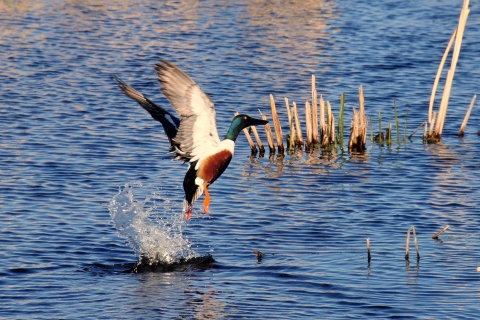
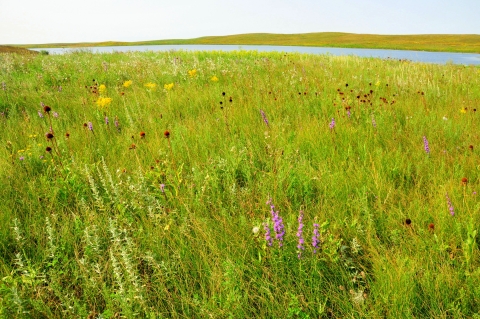
Welcome to Sand Lake National Wildlife Refuge! This area of South Dakota is in the heart of the prairie–pothole region of the northern Great Plains and plays a major role for migratory birds associated with the Central Flyway. Located in north-central South Dakota, these lands and waters are vitally important to the nation’s migratory bird populations. Sand Lake National Wildlife Refuge was designated a Globally Important Bird Area by the American Bird Conservancy and a Wetland of International Importance.

Visit Us

This 21,498-acre refuge includes Sand Lake, a 11,450-acre lake created by the last ice age. Each spring and fall, thousands of waterfowl and other waterbirds migrate through this region, taking advantage of the food found in the nutrient-laden wetlands. The wetland management district wetland management district
A wetland management district is a U.S. Fish and Wildlife Service office that manages waterfowl production areas in one or more counties. Waterfowl production areas are small natural wetlands and grasslands that provide breeding, resting and nesting habitat for waterfowl, shorebirds, grassland birds and other wildlife. The Fish and Wildlife Service acquires waterfowl production areas under the authority of the Migratory Bird Hunting and Conservation Stamp Act, primarily using funds from the sale of Federal Duck Stamps. The Refuge System’s 38 wetland management districts comprise thousands of waterfowl production areas – almost all in the Prairie Pothole Region of the Northern Great Plains.

Learn more about wetland management district
, which includes 8 north central South Dakota counties, is comprised of 43,000 acres of Waterfowl Production Areas. Since waterfowl production area waterfowl production area
Waterfowl production areas are small natural wetlands and grasslands within the National Wildlife Refuge System that provide breeding, resting and nesting habitat for millions of waterfowl, shorebirds, grassland birds and other wildlife. Virtually all waterfowl production areas are in the Prairie Pothole Region states of Iowa, Minnesota, Montana, North Dakota and South Dakota.

Learn more about waterfowl production area
lands are purchased with outdoor enthusiasts' dollars, they are managed so that the public may use them for a variety of activities. These include hunting, hiking, photography, wildlife observation, outdoor education, and interpretation.

Location and Contact Information

      2026 Deer and Upland Game Information

      ALL Refuge gates and roads north of SD HWY 10 will be closed starting September 1st each year. Traditional deer retrieval regulations will still be in effect and can be found in the Sand Lake Hunting and Fishing Regulations.

      ALL Refuge gates and roads south of SD HWY 10 will remain open to all Refuge visitors and user groups, including bowhunters until the beginning of the Refuge gun seasons, RFD-SL1 etc.

      *New as of 2024* – Two enclosed bale blinds were donated to the Refuge.  The blinds are for all Refuge deer hunters to use but were donated in hopes to increase participation by Youth during the Refuge's 2-week Youth Deer season in September.  Both blinds will be placed on the east side of the Refuge, one near 106th St and the other near 108th St.  The blinds cannot be reserved and can be used on a first come-first serve basis.  A map is posted with exact locations.  

      2026

      Deer

      Resident Archery: September 1st, 2026- November 13th, 2026 and December 14th, 2026 - January 1st, 2027

      Non-Resident Archery: October 1st, 2026- November 13th, 2026 and December 14th, 2026 - January 1st, 2027

      Youth Deer: September 12, 2026 - September 30, 2026 YOD-13, Refuge is only open north of SD Hwy 10 for this season

      Muzzleloader ONLY November 14, 2026 - November 18, 2026 RFD-SL1 

      Rifle November 19, 2026 - November 23, 2026 RFD-SL2

      Rifle November 24, 2026 - November 29, 2026 RFD-SL3 (No tags issued in 2025 or 2026 seasons for RFD-SL3)

      Muzzleloader ONLY November 30, 2026 – December 6, 2026 RFD-SL4

      Rifle December 7, 2026 - December 13, 2026 RFD-SL5

      Upland Game

      Ring-necked Pheasant December 14, 2026 - January 31, 2027

      Sharp-tailed Grouse, Grey Partridge December 14, 2026 – January 31, 2027

      2026 UPLAND GAME HABITAT CONDITIONS:

      To be Updated in 2026

      About Us

      The marshes and open water impoundments of the refuge are surrounded by prairie grasslands, cultivated fields, and scattered woodlands along the James River. The wetlands, marshes, open lakes, and grasslands of the refuge are home to more than 266 bird species, 40 mammal species, and a variety of fishes, reptiles, and amphibians. Fall migrations of snow geese may reach peaks of 500,000 individuals, whereas the spring migration has been documented at more than 1.2 million. In addition, more than 123 different bird species nest and raise their young on the refuge.

      What We Do

      Wildlife conservation is at the heart of the National Wildlife Refuge System. The Sand Lake National Wildlife Refuge serves as a breeding and resting ground for migratory birds of all types. Providing quality habitat helps the refuge meet these needs. 
      Our Organization

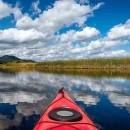
      A bright blue sky obstructed by fluffy white clouds reflected off of a stream shot from inside a kayak
      The U.S. Fish and Wildlife Service manages an unparalleled network of public lands and waters called the National Wildlife Refuge System. With more than 570 refuges spanning the country, this system protects iconic species and provides some of the best wildlife viewing opportunities on Earth.

      Our Library

      Draft Compatibility Determination: Third Party Research, Scientific Collecting and Surveys

      The U.S. Fish and Wildlife Service is seeking public comments on the proposed draft Compatibility Determination for Research, Scientific Collecting and Surveys by Third Parties in the Eastern and Western South Dakota Wetland Management District Complexes. Public comments will be available from...

      Projects and Research