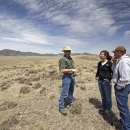
Since the majority of federally listed species occur and depend on privately-owned, non-Federal lands, the U.S. Fish and Wildlife Service (Service) developed an array of tools and incentives to protect the interests of non-Federal property owners while encouraging management actions that support conservation of at-risk and Endangered Species Act (ESA) candidate species in addition to the recovery of ESA listed species. One such tool is Conservation Benefit Agreements (CBAs).
A CBA is a voluntary agreement that provides incentives for non-Federal property owners to conserve at-risk, ESA candidate, and ESA listed species. For the length of the agreement, property owners agree to undertake specific conservation measures for the net conservation benefit of the agreement’s covered species, that help address their identified threats. A range of conservation activities may qualify (as long as they do not have a Federal nexus through ESA section 7), such as:
- Protecting existing populations and habitats;
- Restoring degraded habitat;
- Creating new habitat;
- Improving habitat connectivity;
- Testing and developing new habitat management techniques;
- Augmenting existing populations;
- Restoring historic populations; or
- Not undertaking a specific land management activity.
In return for the property owner’s voluntary conservation action(s), the Service issues an Enhancement of Survival (EOS) permit under ESA section 10(a)(1)(A). The permit authorizes take of the covered species in relation to implementation of the conservation actions and provides the property owner with assurances that their conservation efforts will not result in future regulatory obligations beyond those established in the CBA. If a non-listed species is included in the CBA, the take authorization becomes effective when the species is later listed as an ESA threatened or endangered species. All parties must agree to the provisions detailed in the CBA prior to its completion, as this agreement will support the applicant’s EOS permit application. Prior to the EOS permit expiration, property owners may choose to return the enrolled property to the baseline conditions that existed at the beginning of the CBA if the agreement included that provision prior to permit issuance.
Who Can Participate
Any non-federal property owner can voluntarily participate in a CBA. A property owner can enroll their entire property in the CBA or just a portion of it. The CBA is a collaborative commitment between the Service, the non-federal property owner(s), and any additional cooperators (e.g., State agencies, Tribal governments).Participants should evaluate any potential partnerships that could benefit from the CBAs conservation measures.These conservation measures will aim to provide a net conservation benefit to the covered species. All parties involved must agree to the CBA’s provisions. Federal agencies are not able to participate in CBAs, as they must follow ESA Section 7 Section 7
Section 7 Consultation
The Endangered Species Act (ESA) directs all Federal agencies to work to conserve endangered and threatened species and to use their authorities to further the purposes of the Act. Section 7 of the Act, called "Interagency Cooperation," is the mechanism by which Federal agencies ensure the actions they take, including those they fund or authorize, do not jeopardize the existence of any listed species.
Learn more about Section 7 requirements.
Prior to pursuing an Individual CBA (generally one property owner), awareness of existing CBAs is encouraged for individual, non-Federal property owners to explore the possibility of a formal or informal partnership.Also, if there are multiple property owners interested and willing to obtain similar agreement provisions, a Programmatic CBA or General Conservation Agreement (GCA) can be established for multiple property owners within a county, region, or even an entire state.If an Individual CBA does not encompass the overall conservation effort being sought, explore the flexibilities of these CBA structures:
- Programmatic CBA: A CBA structure where a cooperator, usually a State or local government, or a non-governmental organization (NGO), develops an agreement with assistance from the Service for an area that can include one or several property owners. The cooperator applies for an EOS permit and becomes the primary permit holder under the programmatic CBA and then issues a Certificate of Inclusion to each property owner who agrees to implement the conservation measures in the agreement.
- General Conservation Agreement (GCA): A landscape‑level CBA produced either by the Service, or by another entity in cooperation with the Service. The GCA is adopted by eligible property owners as part of their application for an individual permit, with the applicant’s individual agreement called a GCA-tiered agreement. This approach is recommended in situations where a large‑scale CBA covering many similar actions is needed, but where no applicant is able to serve as a primary permittee.
What is the Property Owner's Role?
The participating property owner(s) collaborates with the Service on drafting the CBA (with the Service usually leading drafting). The property owner then applies to the Service for an EOS permit, supported by the CBA, to cover any covered species “take” “take”
The term “take” means to harass, harm, pursue, hunt, shoot, wound, kill, trap, capture, or collect, or to attempt to engage in any such conduct.
Learn more about “take” from implementing the CBAs covered activities. Property owners are also responsible for providing annual monitoring reports to the Service for the duration of their EOS permit.
What are the Benefits?
For the non-Federal property owner: After receiving an EOS permit, as supported by the CBA, permittees can implement the beneficial conservation measures detailed in the CBA and have assurances that the conservation activities implemented and on-going land management activities occurring will not result in an ESA “take” violation.
For the species: Implementation of a CBAs actions will provide a net conservation benefit for the covered species in the agreement. This can include potentially precluding the need to list at-risk and candidate species, as well as contributing to the recovery of ESA listed species with the goal of species delisting. EOS permits make the elements of the CBA legally binding. Even though CBAs have an option to return to baseline conditions at the end of the agreement period, the Service has found that property owners typically do not exercise this flexibility – resulting in long-lasting conservation impacts for the covered species.
Process
- The Service usually develops the CBA with involvement from property owner. Find your local office.
- Once the CBA and EOS permit application are deemed complete by the Service, we begin processing the permit.
- The ESA requires that all applications under section 10 must be noticed in the Federal Register and available for public comment.
- The Service, as an action agency issuing a permit, is required to comply with National Environmental Policy Act (NEPA), ESA section 7, and National Historic Preservation Act (NHPA).
- Once the consultations, NEPA, and review of application is competed and the Service has addressed any public comments, we decide whether to issue the EOS permit.
- Conservation under the CBA begins after the EOS permit is issued.