


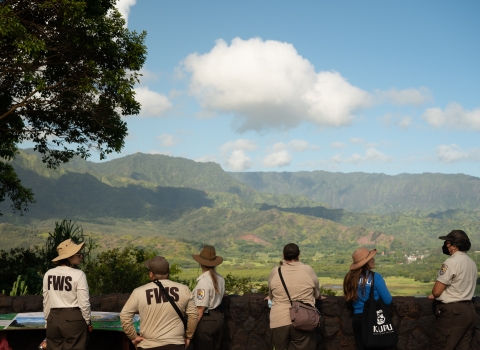
Critical habitat at Hanalei National Wildlife Refuge is closed to the public to protect threatened and endangered birds; however, a viewpoint for HNWR is located just southwest of the Princeville town center.
The viewpoint site is open to the public from 8:30 a.m. to 4:30 p.m., Tuesday through Saturday.
Visit Us
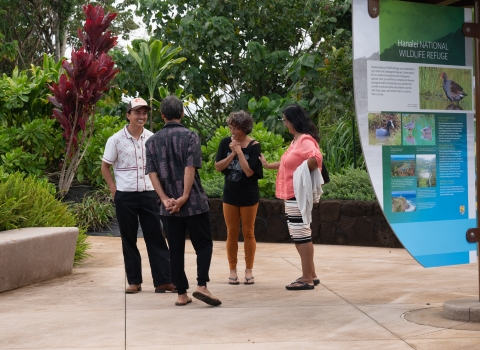
Hanalei National Wildlife Refuge is closed to the public to protect endangered and threatened species of birds. Visitors may overlook Hanalei National Wildlife Refuge from an observation point located along Kūhiō Highway in Princeville. Interpretive signage at the overlook provides information on the Refuge's wildlife and management.
Hikers may drive through the refuge on Ohiki Road to access Okolehao trailhead. Parking is limited. Please drive under 15 mph allowing wildlife to cross the road. Do not stop or park your vehicle along the road.
Location and Contact Information
About Us
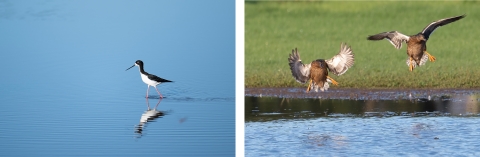
Hanalei National Wildlife Refuge
There has been wetland agriculture in the Hanalei Valley for hundreds of years. Traditional kalo farming practices help maintain waterbird feeding and nesting areas, in conjunction with Service managed wetlands.
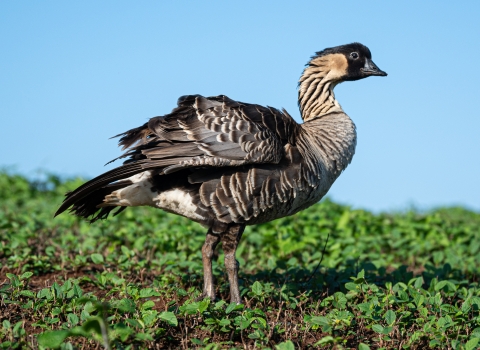
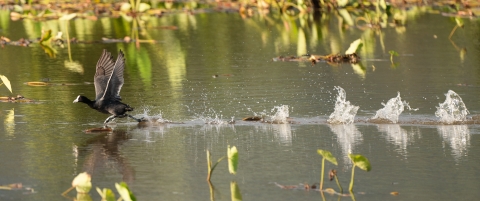
Hanalei National Wildlife Refuge, established in 1972, is the oldest of Kaua‘i's three refuges that are part of the Kauaʻi National Wildlife Refuge Complex. Hanalei NWR was established under the Endangered Species Act to recover threatened and endangered species, including the endangered koloa or (Hawaiian duck, Anas wyvilliana), ‘alae ke‘oke‘o (Hawaiian coot, Fulica alai), ‘alae ‘ula (Hawaiian moorhen, Gallinula chloropus sandvicensis), ae‘o (Hawaiian stilt, Himantopus mexicanus) and nēnē (Hawaiian goose, Branta sandvicensis, now listed as Threatened).
The 917-acre refuge was purchased by the U.S. Fish and Wildlife Service from the Eagle County Development Corporation with Land and Water Conservation Funds. The Refuge is located within a proposed State Historic and Conservation District, and is also home to the Haraguchi Rice Mill which is on the National Register of Historic Places.
What We Do
The U.S. Fish & Wildlife Service manages the Hanalei National Wildlife Refuge to:
- Protect and enhance Hawaiian waterbird populations and provide high quality nesting and feeding habitat.
- Protect and enhance the native plant community and riverine ecosystem.
- Provide opportunities for wildlife observation, interpretation, and environmental education.
Projects and Research
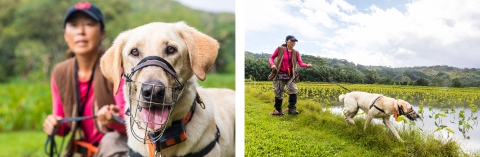
Avian Botulism Detector Dogs in Partnership with Conservation Dogs of Hawaii
Meet Solo, a conservation dog, and her trainer, Kyoko. This yellow lab is being trained to sniff out duck carcasses infected by Avian botulism type C at Hanalei National Wildlife Refuge. The goal is to find carcasses quickly to prevent a botulism outbreak.
Avian botulism type C is a naturally occurring soil bacterium, Clostridium botulinum, which produces a powerful neurotoxin. It occurs year-round in Hawaiʻi due to warm, wet, and stagnant conditions. Since 2011, more than 1,300 waterbirds have been killed or sickened by the disease at Hanalei NWR, with over 90% of the mortalities among five federally endangered species. The koloa maoli (Hawaiian duck, Anas wyvilliana) is most susceptible to botulism, because it’s a dabbler.
Mahalo to our partners, Conservation Dogs of Hawai'i!
To learn more visit: Conservation Dogs of Hawaii